
Who is 118U?

Wrestling has never shied away from a good debate. From arguing over who the greatest college wrestler of all time might be, to weighing whether one title run was tougher than another based on the bracket or weight class depth, the sport thrives on comparison (and competition). At the high school level, those conversations expand even further—this classification versus that classification, or which state has produced the most NCAA champions. It’s the same kind of energy you see in college football when fans claim “DBU” or “QBU”—staking a claim to positional dominance and building a case around history, production, and pipeline. Here at SEWrestle, we’re going to lean into that idea—but with a wrestling twist. With a history that dates back to the first NCAA Championships in 1928 at Iowa State, college wrestling has crowned champions and All-Americans across 37 different weight classes, from the short-lived 114-pound class (wrestled just once in 1948) to the storied Unlimited division that spanned 56 seasons from 1928 through 1986. That kind of depth gives us a unique lens to evaluate dominance—not by position, but by weight. A few days ago - we delved into the 285 lb. weight class and over the coming weeks, we’ll open the door to the debate: which programs have truly built pipelines of talent at specific weight classes over time? Do you agree with our assessments, or do you have your own way of defining the best?
For now, we’ll keep the focus on Division I - but don’t be surprised if this expands to the high school level in Florida, Georgia, and Alabama as we move into the summer. As we’ve started compiling this data, one thing has already become clear: there are going to be some surprises when it comes to which programs rise to the top at specific weights. Our long-term goal is to build out a database of every NCAA qualifier over time, but to get things rolling, we’re starting with a simpler approach - identifying the schools with the most NCAA champions and/or All-Americans at each weight. Along the way, you might see some weights that don’t look familiar by today’s standards - but every class we discuss existed at some point over the past 98 seasons. So now we move to …
The lightweight divisions have long been the proving grounds for some of the toughest competitors the sport has ever seen, and few weights carry more history than 115/118 pounds. While today’s fans may think of 125 as the beginning of the lineup, the road to modern wrestling started much lower. The NCAA first contested 118 pounds from 1931 through 1938 before briefly dropping to 114 in 1948 and then returning to 115 in 1949. In fact, 115 pounds was the smallest weight class when the NCAA Championships began in 1928, and the 115-pound division anchored the lightweight landscape for decades before the weight eventually moved to 118 in 1970. That version of the class remained in place for 28 seasons - from 1970 through 1998 - before the weights shifted upward again in 1999.
Over that span, five wrestlers managed to win three NCAA Division I titles at 115/118 pounds, placing themselves firmly among the legends of the lower weights. Oklahoma State great Rex Peery became the first to do it, winning titles in 1933, 1934, and 1935. Nearly two decades later, his son Hugh Peery carried on the family legacy for Pittsburgh, winning crowns from 1952 through 1954. Then came the legendary Gray Simons, who dominated the 115-pound division from 1960 through 1962 before building one of the most respected coaching careers in wrestling history. Simons led programs at Lock Haven, Indiana State, and Old Dominion, but in the DirtySouth he remains synonymous with Tennessee Volunteers wrestling, guiding the Volunteers from 1976 through 1986 and posting a 92-56 dual record before the program was shuttered during the Title IX era. His impact on the sport extended far beyond his championships, making him one of the defining figures of the 115/118-pound lineage.
The 1970s belonged to Michigan State star Greg Johnson, who was once described by legendary coach Grady Peninger as “the physically toughest wrestler he ever coached.” After injuries cost him multiple seasons, Johnson finally got a full opportunity in 1970 and made the most of it, going 19-1 while capturing the NCAA title at 118 pounds. He would finish his career at 52-3-2 while winning three straight NCAA crowns from 1970-1972. The final three-time champion at 118 came from Bloomsburg, where Ricky Bonomo etched his name into history from 1985 through 1987. Bonomo nearly never wrestled collegiately at all (want that story - click the link above), but he went on to finish with a 116-12-3 career record while becoming the last wrestler to claim three NCAA Division I titles at 118 pounds. Together, those five names helped define one of the deepest and toughest weight classes college wrestling has ever known.
And while 115/118 produced some of the most recognizable names in NCAA wrestling history from 1928 through 1998, the overall distribution of champions paints a much different picture. Across 57 NCAA tournaments, 25 different programs crowned a national champion at 114, 115, or 118 pounds - a reminder that the lightweight divisions have historically been some of the sport’s deepest and most competitive brackets. Interestingly, the only time 118 pounds existed prior to 1970, Oklahoma State completely controlled the weight, as Rex Peery and Joe McDaniel combined to win five NCAA titles for the Cowboys. If you isolate just the 114/115-pound era without the later 118-pound years, the conversation shifts toward Lock Haven and Pittsburgh thanks largely to the dominance of Gray Simons and Hugh Peery.
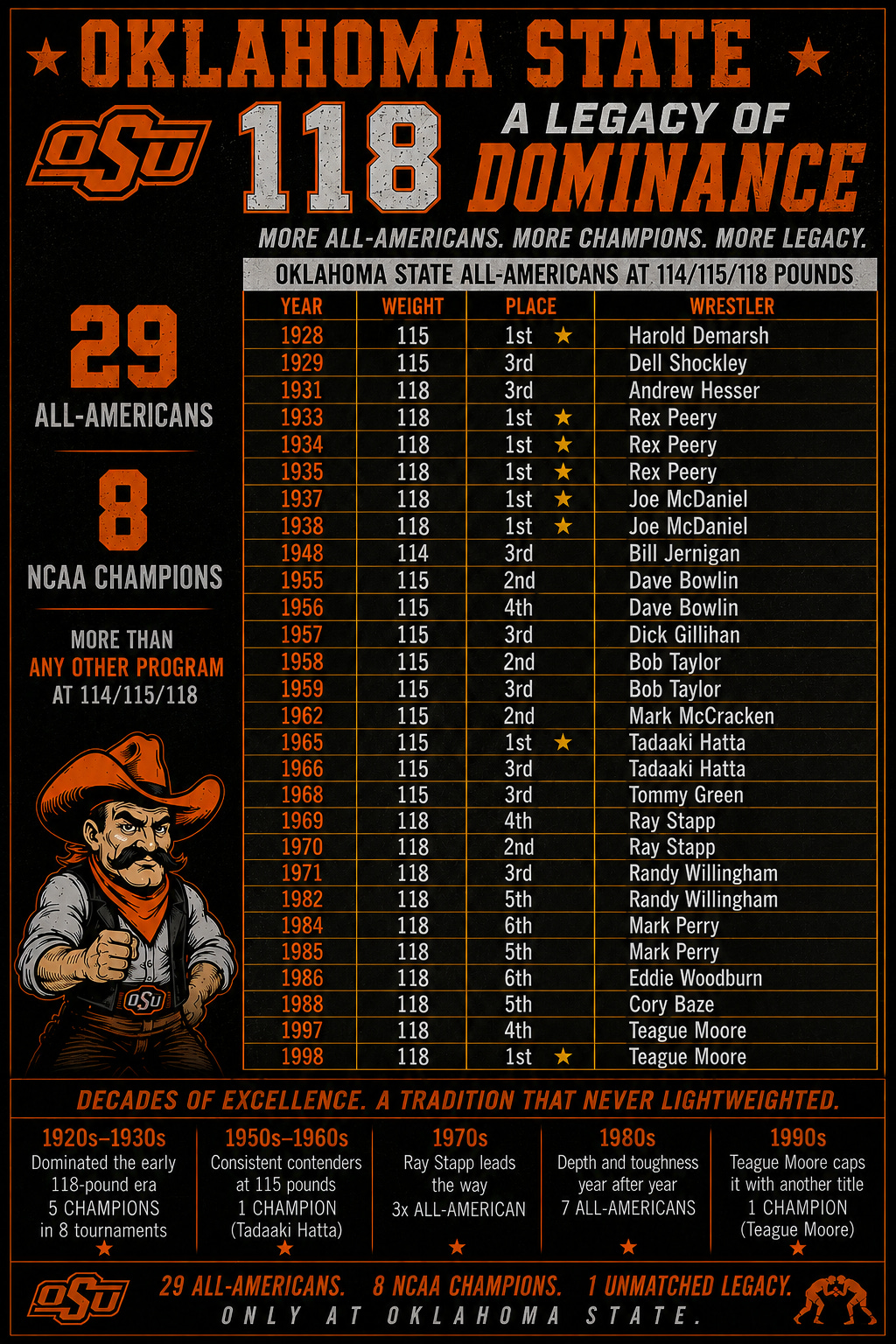
But when the focus turns from champions to consistency, Oklahoma State still stands above the rest. The Cowboys produced 29 All-Americans and eight national champions across the combined 114/115/118-pound lineage, the most of any program. Behind them sit the Iowa Hawkeyes and the Iowa State Cyclones with 24 All-Americans each. Iowa converted that consistency into five national titles, while Iowa State carries one of the sport’s strangest statistical quirks: despite producing 24 All-Americans and six NCAA finalists at the weight, the Cyclones never crowned a national champion at 114, 115, or 118 pounds.
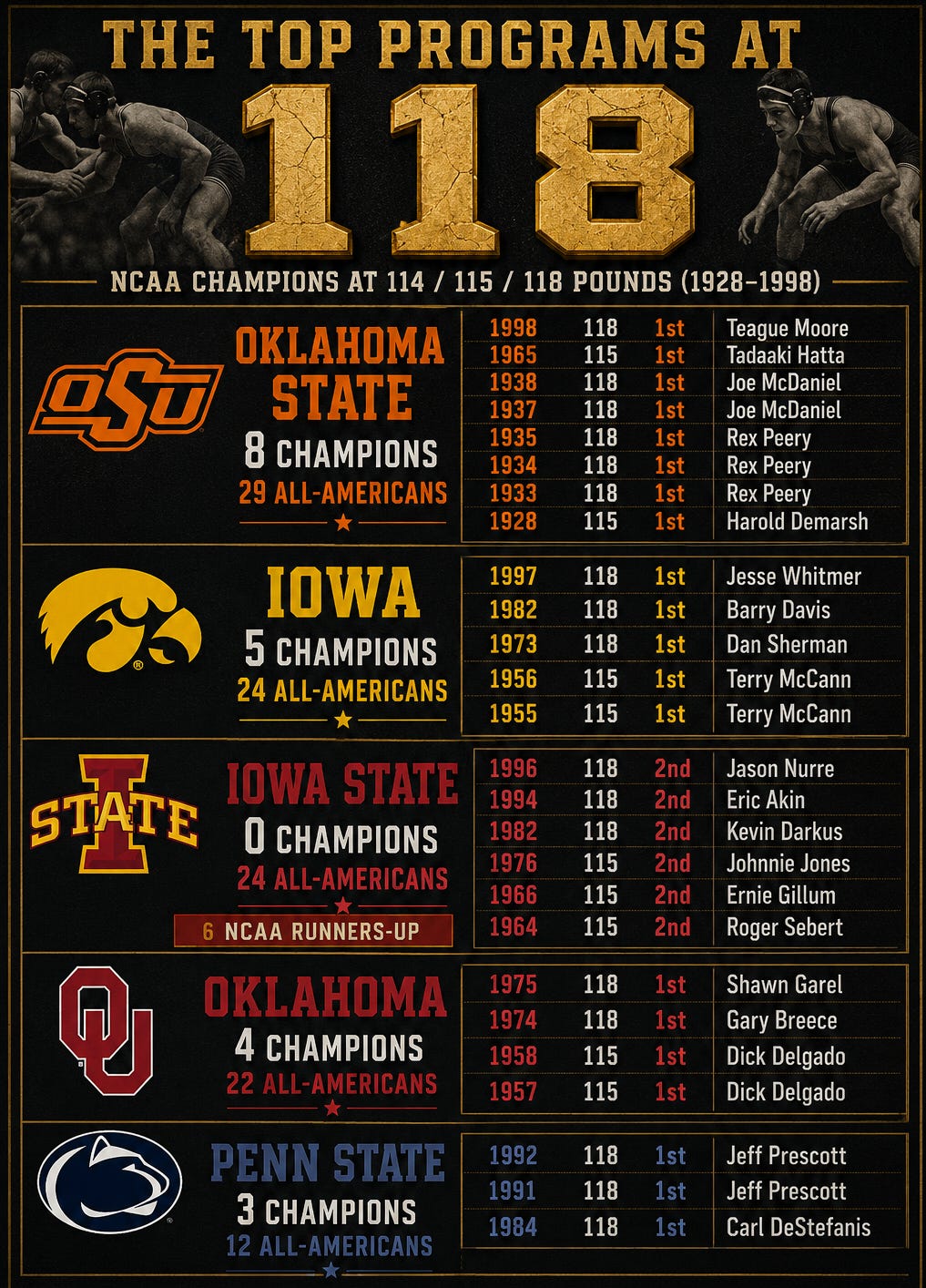
Programs also with a 114/115/118 lb. Champion include:
Bloomsburg - Ricky Bonomo (‘85, ‘86, ‘87)
Cal Poly-SLO - Mark DiGirolamo (‘76)
Cal State-Bakersfield - Adam Cuestas (‘83) & Joe Gonzales (‘80)
Clarion - Sheldon Thomas (‘96)
Clemson - Sam Henson (‘93, ‘94)
East Stroudsburg - Jack Cuvo (‘88, ‘89)
Illinois - Joe Sapora (115 - ‘29, ‘30)
Lehigh - John Engel (‘31)
Lock Haven - Gray Simons (115 - ‘60, ‘61, ‘62) & Ken Melchior (115 - ‘68)
Michigan State - Greg Johnson (‘70, ‘71, ‘72) & Kelvin Jackson (‘95)
Minnesota State-Moorhead - Arthur Maughan (‘63)
Northwestern - Jack Griffin (‘90)
Ohio - Andy Daniels (‘78)
Oregon - John Miller (115 - ‘69)
Pittsburgh - Hugh Peery (115 - ‘52, ‘53, ‘54)
Portland State - Rick Sanders (115 - ‘66, ‘67)
Purdue - Arnold Plaza (114 - ‘48)
SIU-Carbondale - Terry Finn (115 - ‘64)
Syracuse - Gene Mills (‘79, ‘80)
Wisconsin - Jim Haines (‘77)
Yale - Andy Fitch (115 - ‘59)
If there’s a true standard bearer for 118U, it’s the Oklahoma State Cowboys. The Cowboys didn’t just produce champions at 114/115/118 - they built an assembly line of lightweight greatness. Their 29 All-Americans and 8 NCAA champions stand well above the rest of the field, fueled by legendary names like Rex Peery and Joe McDaniel, who helped establish Oklahoma State’s early dominance at the weight. But the depth of the lineup is what truly separates the Cowboys from the pack. Three-time All-American Ray Stapp added another chapter to the legacy, while stars like Tadaaki Hatta and Teague Moore carried the tradition across multiple eras of college wrestling. From the earliest NCAA tournaments through the modern era, Oklahoma State consistently turned the lightest weight class into one of the program’s greatest strengths—and that consistency is exactly why the Cowboys sit atop the 118U conversation.
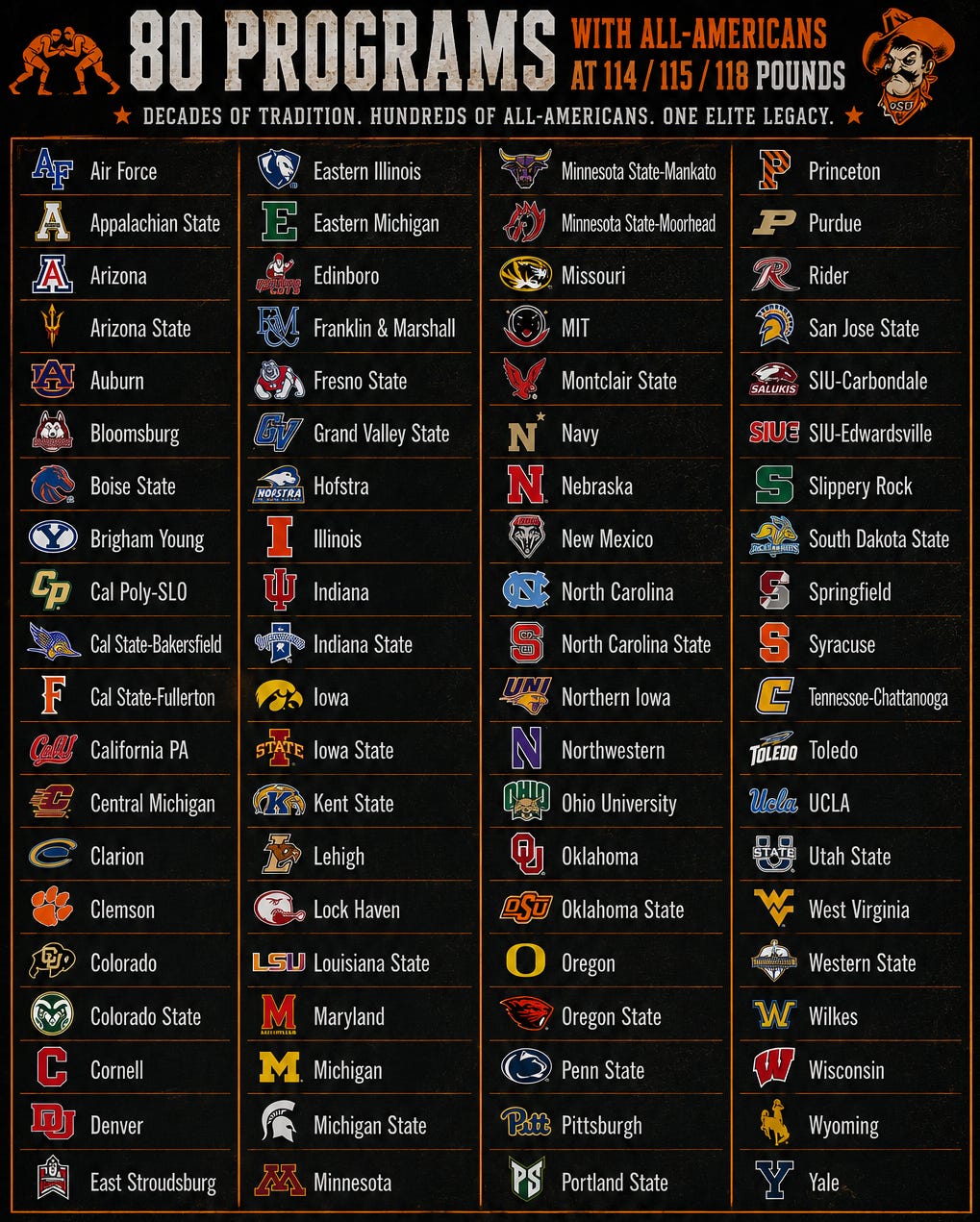
Below are the 80 programs to have at least one 114/115/118 lb. All American.
Sign up to get a daily dose from SEWrestle delivered straight to your inbox, or be sure to check back in a day or two as we roll on to the next weight. We’ve now highlighted Minnesota at 285 and Oklahoma State at 118 … what weight is next?