
Who is 285U?

Wrestling has never shied away from a good debate. From arguing over who the greatest college wrestler of all time might be, to weighing whether one title run was tougher than another based on bracket strength or weight class depth, the sport thrives on comparison (and competition). At the high school level, those conversations expand even further—this classification versus that classification, or which state has produced the most NCAA champions. It’s the same kind of energy you see in college football when fans claim “DBU” or “QBU”—staking a claim to positional dominance and building a case around history, production, and pipeline. Here at SEWrestle, we’re going to lean into that idea—but with a wrestling twist. With a history that dates back to the first NCAA Championships in 1928 at Iowa State, college wrestling has crowned champions and All-Americans across 37 different weight classes, from the short-lived 114-pound class (wrestled just once in 1948) to the storied Unlimited division that spanned 56 seasons from 1928 through 1986. That kind of depth gives us a unique lens to evaluate dominance—not by position, but by weight. Over the coming weeks, we’ll open the door to the debate: which programs have truly built pipelines of talent at specific weight classes over time? Do you agree with our assessments, or do you have your own way of defining the best?
For now, we’ll keep the focus on Division I college wrestling—but don’t be surprised if this expands to the high school level in Florida, Georgia, and Alabama as we move into the summer. As we’ve started compiling this data, one thing has already become clear: there are going to be some surprises when it comes to which programs rise to the top at specific weights. Our long-term goal is to build out a database of every NCAA qualifier over time, but to get things rolling, we’re starting with a simpler approach—identifying the schools with the most NCAA champions and/or All-Americans at each weight. Along the way, you might see some weights that don’t look familiar by today’s standards—but every class we discuss existed at some point over the past 98 seasons. With that, we’ll kick things off at the top of the current lineup—285 pounds.

The 285-pound weight class may feel like a staple of today’s lineup, but it’s actually one of the newer additions—contested just 27 times since its debut in 1999. It didn’t take long for the division to make an impact, as Cal State Bakersfield’s Stephen Neal claimed the inaugural title with a win over future WWE and UFC star Brock Lesnar, who would return the following year to capture gold in 2000 over Iowa’s Wes Hand.
And while heavyweight has produced some of the sport’s most recognizable names over the past quarter century, the distribution of champions tells a deeper story. In those 27 tournaments, 13 different programs have crowned a 285-pound national champion—but only five schools have done it more than once. It’s a weight defined not by one dominant dynasty, but by bursts of excellence—programs rising up, producing elite heavyweights, and leaving their mark before the landscape shifts again.
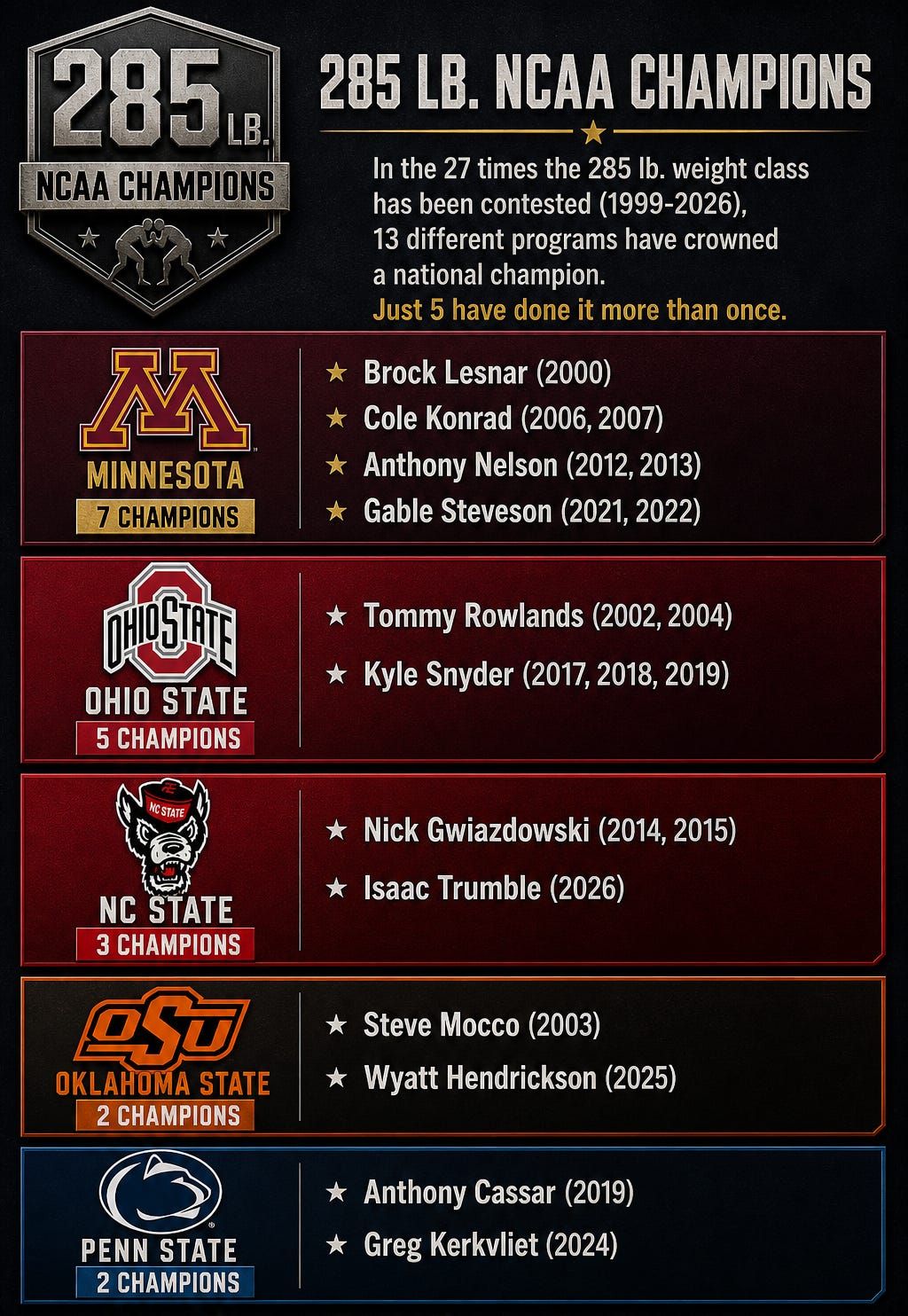
Programs also with a 285 lb. Champion include:
Cal State Bakersfield - Stephen Neal (1999)
Illinois - John Lockhart (2001)
Iowa - Steve Mocco (2003)
Northwestern - Dustin Fox (2008)
Missouri - Mark Ellis (2009)
Iowa State - David Zabriskie (2010)
Leigh - Zachary Rey (2011)
Michigan - Mason Parris (2023)
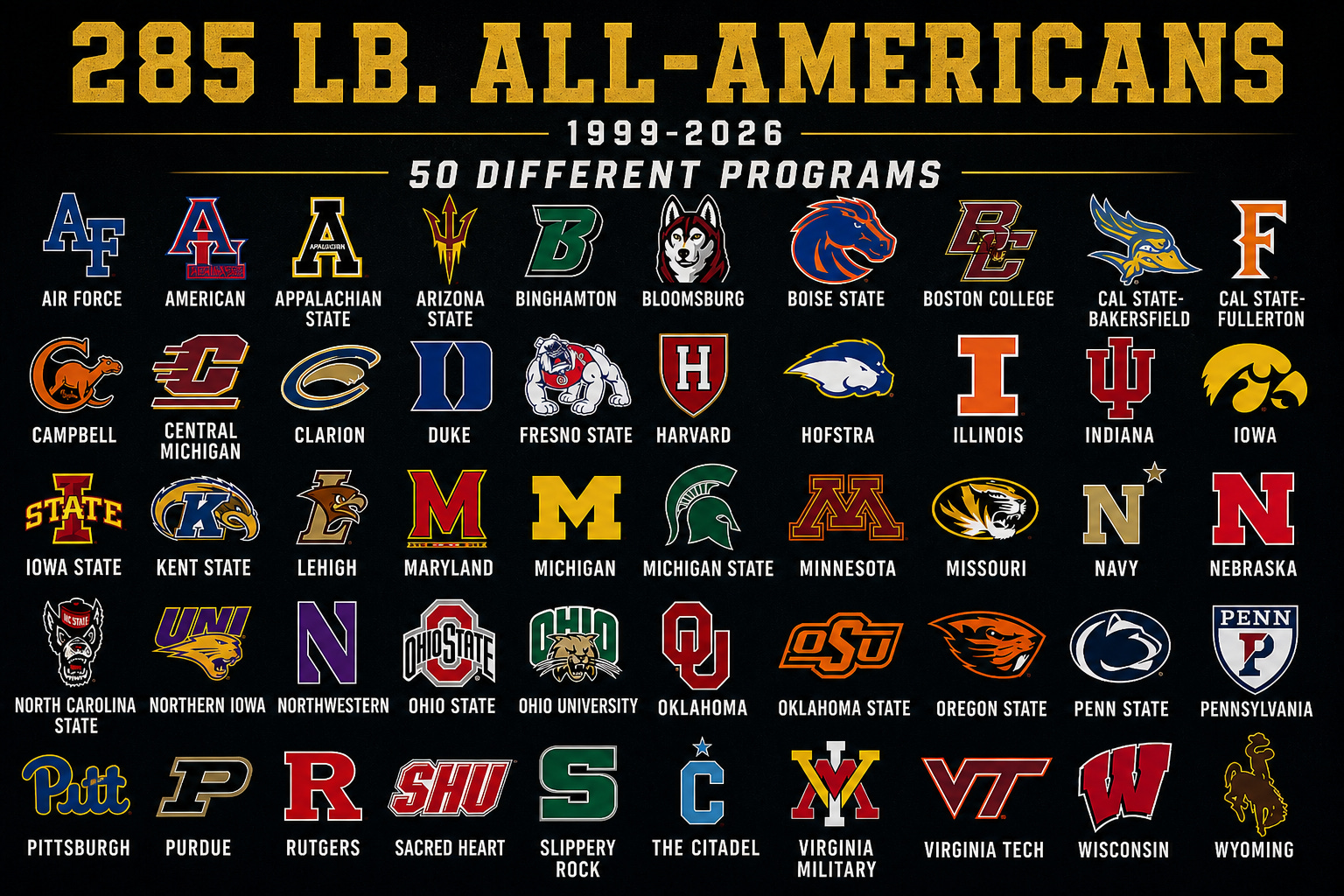
While champions often grab the spotlight, the All-American count tells an even deeper story of sustained success—and at 285, it reinforces just how consistent certain programs have been. Since 1999, 50 different schools have produced at least one heavyweight All-American, but it’s Minnesota Golden Gophers that set the standard. Minnesota has placed a heavyweight on the podium in 19 of the 27 NCAA tournaments, a remarkable level of consistency at the sport’s most volatile weight.
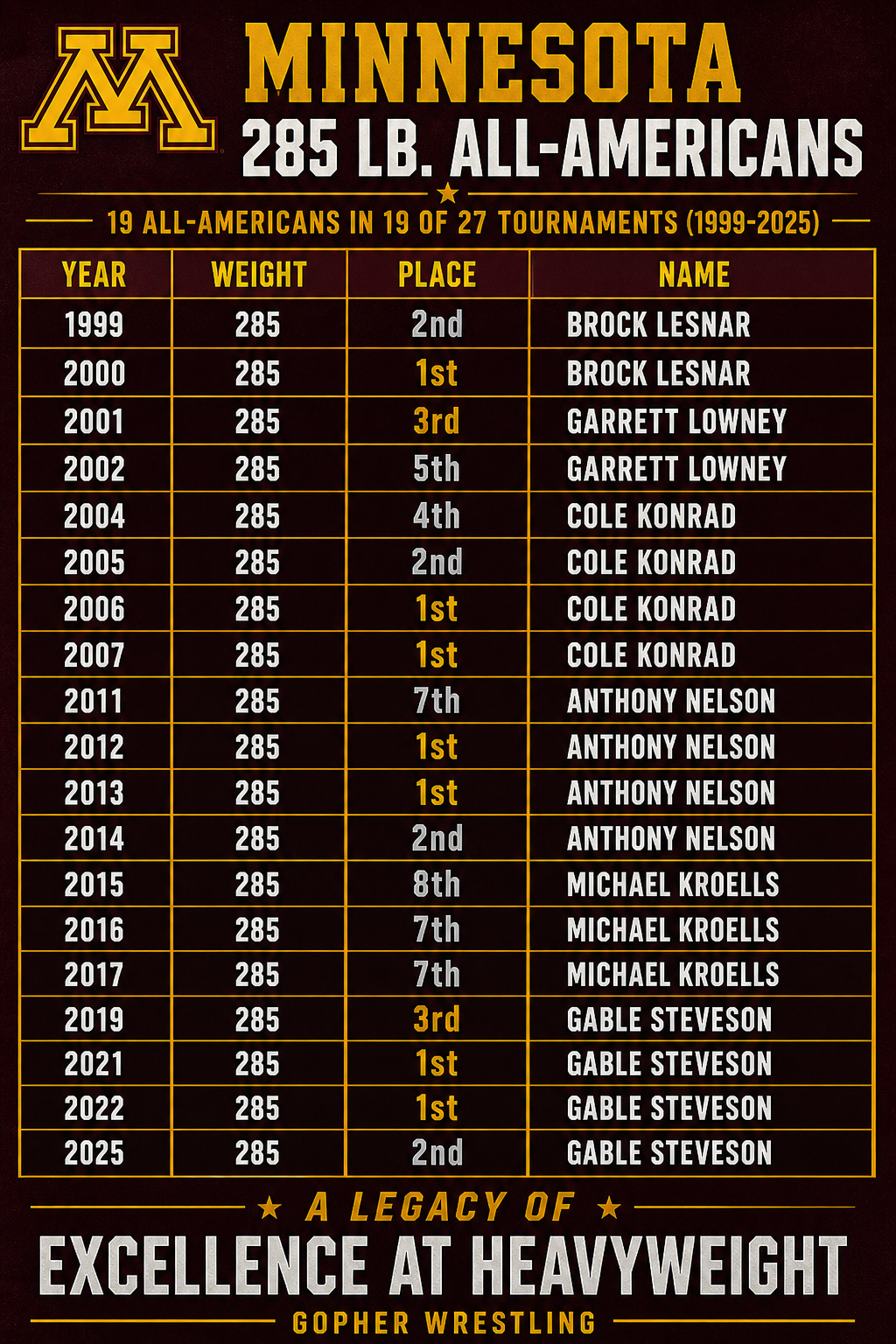
Behind them, Iowa Hawkeyes and Michigan Wolverines—each with just one national champion—are tied for second with 15 All-Americans apiece. Oklahoma State Cowboys and Penn State Nittany Lions follow closely with 12, while Ohio State Buckeyes and Arizona State Sun Devils round out the top tier with 11 each. It’s a reminder that while titles define peaks, All-Americans define pipelines—and at heavyweight, a few programs have clearly built both.
Below are the 50 programs to have at least one 285 lb. All American since 1999.
Sign up to get a daily dose from SEWrestle delivered straight to your inbox, or be sure to check back in a day or two as we roll on to the next weight. If Minnesota is staking its claim as 285U, the question naturally follows—can they carry that same dominance to UNL (Unlimited U)? Yes, once upon a scale there was an unlimited class at both the high school and college levels, and it produced its own legends along the way. So what’s next—do we dive into the giants of the past, or shift gears and head down to a lighter weight?